If you're shopping for an electric dirt bike, you've probably asked: mid-drive vs hub motor: which is better for an electric dirt bike? The answer depends on your terrain, budget, and how you ride. While mid-drive systems excel on steep, technical singletrack, modern high-torque geared hub motors—like those in Riding Times' GT73 Pro and GT54 PRO—deliver exceptional off-road performance with lower cost, simpler maintenance, and real-world torque figures that rival many mid-drive competitors.
In this guide, we'll compare both motor types, explain the engineering trade-offs, and show why Riding Times electric dirt bikes are engineered to give you the best balance of power, durability, and value for trail riding, commuting, and weekend adventures.
Understanding the Core Difference: Mid-Drive vs Hub Motor
The fundamental distinction lies in where the motor sits and how it delivers power to the ground.
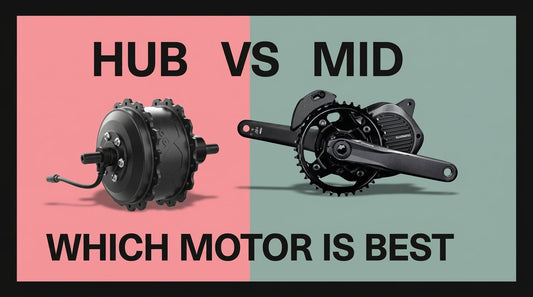
- Mid-drive motors are mounted at the bike's bottom bracket (center of the frame) and drive the chain, using the bike's gears to multiply torque at the rear wheel.
- Hub motors are integrated directly into the rear (or front) wheel hub, delivering power straight to the ground without a chain or external gearbox.

This difference affects weight distribution, torque delivery, maintenance, and cost.
Mid-Drive Motors: The Performance Standard
Mid-drive systems are considered the "gold standard" for high-performance electric dirt bikes because they centralize weight and leverage the drivetrain's gearing.
Key advantages:
- Superior weight balance: Motor mass sits low and centered, improving handling on technical terrain.
- Torque multiplication: The motor spins at optimal RPM while the gears multiply torque at the wheel, enabling steep climbs (20°–35° inclines).
- Better efficiency on varied terrain: Mid-drives can stay in their efficiency band across different speeds and loads.
Trade-offs:
- Higher cost: Mid-drive systems are more complex to manufacture and integrate.
- More maintenance: Chains, cassettes, and derailleurs wear faster under high torque.
- Unsprung weight remains low, but the drivetrain is exposed to dirt, mud, and impacts.
Hub Motors: Simplicity Meets High Torque
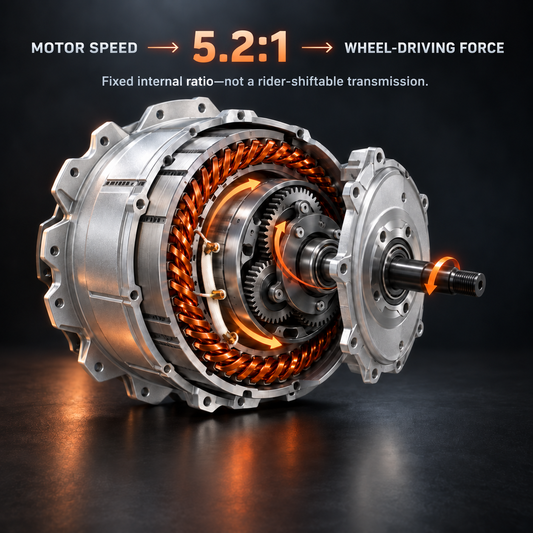
Hub motors are sealed units built into the wheel, offering a simpler, lower-maintenance alternative. Modern geared hub motors (like those in Riding Times bikes) use internal planetary gears to multiply torque while keeping weight reasonable.
Key advantages:
- Lower cost: Hub motors are cheaper to produce and install.
- Minimal maintenance: No chain wear, no derailleur adjustments, sealed against weather.
- High torque at the wheel: Direct drive or geared hub motors can deliver 60–338 Nm directly at the rear wheel.
- Reliability: Fewer moving parts mean fewer failure points.
Trade-offs:
- Unsprung weight: Motor mass in the wheel can affect suspension response on rough terrain.
- Fixed gear ratio: Hub motors can't leverage external gearing, so efficiency drops on very steep, sustained climbs.
Torque, Power, and Real-World Performance
When comparing motors, torque (Nm) matters more than wattage alone for off-road capability. Here's how Riding Times models stack up:
| Model | Motor Type | Peak Power | Torque (Nm) | Top Speed | Range | Best For |
|---|---|---|---|---|---|---|
| GT73 Pro | Rear Gear Hub Motor | 3000W | 338 Nm | 50 MPH | 87 miles | Adults, aggressive trail riding |
| GT73 | Rear Gear Hub Motor | 2400W | 126 Nm | 37 MPH | 51 miles | Intermediate riders, mixed terrain |
| GT54 PRO | Rear Hub Motor | 3000W | 338 Nm | 49 MPH | 62 miles | Teens & adults, compact agility |
| GT54 | Rear Hub Motor | 2000W | 290 Nm | 39 MPH | 60 miles | Youth, entry-level off-road |
| Z8 | Rear Hub Motor | 1500W | ~ | 28 MPH | 75 miles | Urban commuting, moped-style |
| GT33 | Rear Hub Motor | 1350W |
258 Nm |
31 MPH | 100 miles | Urban commuting with cargo |
Riding Times' GT73 Pro and GT54 PRO deliver 338 Nm of torque—figures that rival or exceed many mid-drive competitors in the $3,000–$5,000 range.
Torque Calculation Example
To illustrate why torque matters, consider climbing a 20° incline with a total system weight (rider + bike) of 250 lbs (~113 kg). The force required at the rear wheel is:
F=m⋅g⋅sin(θ)
Where:
- m=113kg
- g=9.81m/s2
- θ=20°
F=113⋅9.81⋅sin(20°)≈113⋅9.81⋅0.342≈378N
For a rear wheel radius of ~0.3 m (25" tire), the torque required at the wheel is:
τ=F⋅r=378⋅0.3≈113Nm
A GT73 (126 Nm) or GT54 (290 Nm) can comfortably handle this climb, while the GT73 Pro (338 Nm) provides significant reserve for acceleration, mud, or steeper grades.
Handling, Weight Distribution, and Suspension
One common criticism of hub motors is unsprung weight—the motor mass in the wheel can make the suspension feel less responsive on bumpy trails. However, modern geared hub motors (like Riding Times' 2400W–3000W units) are compact and well-balanced, minimizing this effect for most riders.
Mid-drive advantages:
- Centralized weight improves cornering stability and reduces rear-end "heaviness.
- Lower unsprung weight allows the suspension to track the ground more accurately over whoops and rocks.
Hub motor realities:
- For fire roads, dirt trails, and moderate technical terrain, the handling difference is negligible for most riders.
- Riding Times bikes feature full hydraulic suspension (front and rear) to compensate for any unsprung weight, delivering a plush ride on rough ground.
Maintenance, Durability, and Total Cost of Ownership

This is where hub motors shine.
| Factor | Mid-Drive | Hub Motor (Riding Times) |
|---|---|---|
| Chain/cassette wear | High (torque through drivetrain) | None (direct wheel drive) |
| Weather resistance | Moderate (exposed chain) | Excellent (sealed unit) |
| Maintenance frequency | Regular chain lube, cassette replacement | Minimal (tire changes only) |
| Repair complexity | Higher (drivetrain components) | Lower (wheel swap if needed) |
| Cost | $3,000–$6,000+ | $999–$1,999 (Riding Times) |
Efficiency and Range: Hub vs Mid-Drive on Real Trails
Mid-drive motors are often cited as 20% more efficient on mixed terrain because they can stay in their optimal RPM band. However, this advantage diminishes on flat to moderate trails, where hub motors achieve 85–92% efficiency at optimal load
Why Riding Times Hub Motors Are the Smart Choice for Most Riders
While mid-drive systems have their place in elite motocross and extreme hill-climb scenarios, Riding Times electric dirt bikes are engineered for the majority of riders who want:
- High torque at an affordable price: 126–338 Nm from $999–$1,999.\Low maintenance: No chain wear, sealed motors, UL 2849 safety.
- Real-world range: 51–87 miles on a single charge.
- Versatility: From urban commuting (Z8) to aggressive trail riding (GT73 Pro).
- Community and support: U.S. repair centers, 2-year warranty, active Facebook rider group.
Visit Riding Times to explore our full lineup, read customer reviews, and join thousands of happy riders worldwide.